Note
Go to the end to download the full example code
Loading example data#
This example shows how to use the loader functions to load example data.
Laboratory data#
We provide a small subset of the TVS dataset of the Mobilise-D project as example data.
The data only contains a small number of participants and only two (instead of the ten) laboratory tests of each
participant.
The data is stored in the examples/data folder of the repository in the Mobilise-D matlab format [1].
Dataset Class#
We provide a LabExampleDataset class to load the example data.
This is the easiest way to access the example data and allows you to select and iterate over the data in an easy way.
from mobgap.data import LabExampleDataset

example_data = LabExampleDataset()
You can select the data you want using the get_subset method.
ha_example_data = example_data.get_subset(cohort="HA")
ha_example_data
Once you selected only a single row of the dataset (either by repeated get_subset or by iteration), you can load
the actual data.
single_test = ha_example_data.get_subset(
    participant_id="002", test="Test5", trial="Trial2"
)
single_test
The raw IMU data can be accessed in two ways:
.datawhich contains a dictionary with the data of all IMU sensors in the dataset. Per default, we only load the data of the “LowerBack” sensor for performance reasons. But, you can select the sensors to load using theraw_data_sensorandsensor_psotionsargument of the Dataset class.
imu_data = single_test.data["LowerBack"]
imu_data
/home/docs/checkouts/readthedocs.org/user_builds/mobgap/checkouts/v0.9.0/mobgap/data/_mobilised_matlab_loader.py:1189: UserWarning: Global caching is a little tricky to get right and our implementation is not yet battle-tested. Please double check that the results are correct and report any issues you find.
  return hybrid_cache(self.memory, 1)(_load_test_data_without_checks)(
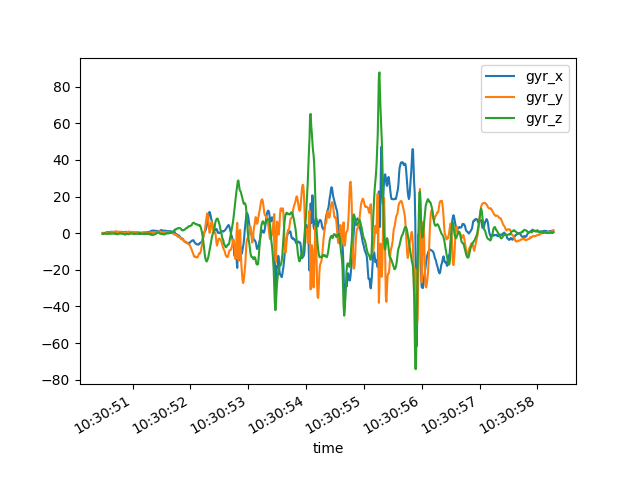
.data_sswhich contains only the data of the “single sensor”. This is the data used as input for all algorithms in the provided pipelines. In most cases this is equivalent to the data of the “LowerBack” sensor, but a different position can be selected using thesingle_sensor_position(orsingle_sensor_namein some Dataset classes) argument of the Dataset class.
single_sensor_data = single_test.data_ss
single_sensor_data
import matplotlib.pyplot as plt

single_sensor_data.filter(like="gyr").plot()
plt.show()
Test-level metadata:
single_test.recording_metadata
{'start_date_time_iso': '2020-08-21T12:30:50.479+02:00', 'time_zone': 'Europe/Berlin', 'sampling_rate_hz': 100.0, 'reference_sampling_rate_hz': None, 'measurement_condition': 'laboratory', 'recording_identifier': ('TimeMeasure1', 'Test5', 'Trial2')}
Participant-level metadata:
single_test.participant_metadata
{'cohort': 'HA', 'foot_length_cm': 26.4, 'handedness': 'right', 'height_m': 1.75, 'indip_data_used': 'All', 'sensor_attachment_su': 'Body-Worn', 'sensor_height_m': 1.08, 'sensor_type_su': 'MM+', 'walking_aid_used': False, 'weight_kg': 82.0}
You can also load the reference system data, by specifying the reference_system argument.
All parameters related to the reference systems have a trailing underscore.
example_data_with_reference = LabExampleDataset(reference_system="Stereophoto")
single_trial_with_reference = example_data_with_reference.get_subset(
    cohort="HA", participant_id="002", test="Test5", trial="Trial2"
)
single_trial_with_reference.raw_reference_parameters_
{'lwb': [{'Start': 2.28, 'End': 5.39, 'StrideFrequency': 49.36164888953828, 'Cadence': 98.72329777907656, 'Duration': 3.11, 'Length': 4.113706815831932, 'LengthFeet': 3.990970590722213, 'WalkingSpeed': 1.3727010349957065, 'AverageStrideLength': 1.6696087035787461, 'NumberStrides': 4.0, 'TerminationReason': 'Pause', 'Break_Start': array([], dtype=float64), 'Break_End': array([], dtype=float64), 'Break_Number': array([], dtype=float64), 'Break_Duration': array([], dtype=float64), 'Turning_Flag': 0.0, 'Turn_Start': array([], dtype=float64), 'Turn_End': array([], dtype=float64), 'Turn_Duration': array([], dtype=float64), 'Turn_Number': array([], dtype=float64), 'Turn_Angle': array([], dtype=float64), 'Turn_NumberStrides': array([], dtype=float64), 'Turn_AngularVelocity': array([], dtype=float64), 'Turn_PeakAngularVelocity': array([], dtype=float64), 'Turn_MeanAngularVelocity': array([], dtype=float64), 'Turn_Length': array([], dtype=float64), 'Stride_Duration': array([1.28, 1.18, 1.16, 1.25]), 'Stride_Length': array([1.6130588 , 1.59518995, 1.65295507, 1.81723099]), 'Stride_Height': array([ 0.00258984,  0.0019533 , -0.00603833, -0.01509003]), 'Stride_Speed': array([1.26020219, 1.35185589, 1.42496127, 1.45378479]), 'Stride_TrunkElevationChange': array([0.015336  , 0.00167007, 0.00736727, 0.03591326]), 'Stance_Duration': array([0.85, 0.74, 0.75, 0.73]), 'Swing_Duration': array([0.43, 0.44, 0.41, 0.52]), 'SingleSupport_Duration': array([ nan, 0.87, 0.85, 0.93]), 'DoubleSupport_Duration': array([ nan, 0.31, 0.31, 0.32]), 'Stance_Length': array([0.22870683, 0.20503215, 0.2409645 , 0.24516186]), 'Swing_Length': array([1.37562656, 1.38826616, 1.40289499, 1.56628489]), 'Stance_Speed': array([0.26906685, 0.27707047, 0.32128599, 0.33583817]), 'Swing_Speed': array([3.19913153, 3.15515037, 3.42169511, 3.01208632]), 'SingleSupport_Length': array([], dtype=float64), 'DoubleSupport_Length': array([], dtype=float64), 'SingleSupport_Speed': array([], dtype=float64), 'DoubleSupport_Speed': array([], dtype=float64), 'Stride_InitialContacts': array([[2.28, 3.56],
       [2.96, 4.14],
       [3.56, 4.72],
       [4.14, 5.39]]), 'InitialContact_Event': array([2.28, 2.96, 3.56, 4.14, 4.72, 5.39]), 'InitialContact_LeftRight': array(['Left', 'Right', 'Left', 'Right', 'Left', 'Right'], dtype=object), 'FinalContact_Event': array([3.13, 3.7 , 4.31, 4.87]), 'FinalContact_LeftRight': array(['Left', 'Right', 'Left', 'Right'], dtype=object), 'Step_Duration': array([0.68, 0.6 , 0.58, 0.58, 0.67]), 'Step_Length': array([0.78400307, 0.79455085, 0.78468028, 0.83038434, 0.92008828]), 'Step_Length_Feet': array([0.79563927, 0.81137347, 0.78349089, 0.87076342, 0.95103785]), 'Step_Speed': array([1.15294569, 1.32425142, 1.35289704, 1.43169713, 1.37326609]), 'Step_TrunkElevationChange': array([0.00490894, 0.01042706, 0.01209712, 0.01946439, 0.01644887])}], 'wb': [{'Start': 2.28, 'End': 5.39, 'StrideFrequency': 49.36164888953828, 'Cadence': 98.72329777907656, 'Duration': 3.11, 'Length': 4.113706815831932, 'LengthFeet': 3.990970590722213, 'WalkingSpeed': 1.3727010349957065, 'AverageStrideLength': 1.6696087035787461, 'NumberStrides': 4.0, 'TerminationReason': 'Pause', 'Break_Start': array([], dtype=float64), 'Break_End': array([], dtype=float64), 'Break_Number': array([], dtype=float64), 'Break_Duration': array([], dtype=float64), 'Turning_Flag': 0.0, 'Turn_Start': array([], dtype=float64), 'Turn_End': array([], dtype=float64), 'Turn_Duration': array([], dtype=float64), 'Turn_Number': array([], dtype=float64), 'Turn_Angle': array([], dtype=float64), 'Turn_NumberStrides': array([], dtype=float64), 'Turn_AngularVelocity': array([], dtype=float64), 'Turn_PeakAngularVelocity': array([], dtype=float64), 'Turn_MeanAngularVelocity': array([], dtype=float64), 'Turn_Length': array([], dtype=float64), 'Turning_SharpTurn_Flag': array([], dtype=float64), 'Incline_Start': array([], dtype=float64), 'Incline_End': array([], dtype=float64), 'Incline_Duration': array([], dtype=float64), 'Incline_Number': array([], dtype=float64), 'Incline_NumberStrides': array([], dtype=float64), 'Incline_PositiveElevation': array([], dtype=float64), 'Incline_NegativeElevation': array([], dtype=float64), 'Stride_Duration': array([1.28, 1.18, 1.16, 1.25]), 'Stride_Length': array([1.6130588 , 1.59518995, 1.65295507, 1.81723099]), 'Stride_Height': array([ 0.00258984,  0.0019533 , -0.00603833, -0.01509003]), 'Stride_Speed': array([1.26020219, 1.35185589, 1.42496127, 1.45378479]), 'Stride_TrunkElevationChange': array([0.015336  , 0.00167007, 0.00736727, 0.03591326]), 'Stance_Duration': array([0.85, 0.74, 0.75, 0.73]), 'Swing_Duration': array([0.43, 0.44, 0.41, 0.52]), 'SingleSupport_Duration': array([ nan, 0.87, 0.85, 0.93]), 'DoubleSupport_Duration': array([ nan, 0.31, 0.31, 0.32]), 'Stance_Length': array([0.22870683, 0.20503215, 0.2409645 , 0.24516186]), 'Swing_Length': array([1.37562656, 1.38826616, 1.40289499, 1.56628489]), 'Stance_Speed': array([0.26906685, 0.27707047, 0.32128599, 0.33583817]), 'Swing_Speed': array([3.19913153, 3.15515037, 3.42169511, 3.01208632]), 'SingleSupport_Length': array([], dtype=float64), 'DoubleSupport_Length': array([], dtype=float64), 'SingleSupport_Speed': array([], dtype=float64), 'DoubleSupport_Speed': array([], dtype=float64), 'Stride_InitialContacts': array([[2.28, 3.56],
       [2.96, 4.14],
       [3.56, 4.72],
       [4.14, 5.39]]), 'InitialContact_Event': array([2.28, 2.96, 3.56, 4.14, 4.72, 5.39]), 'InitialContact_LeftRight': array(['Left', 'Right', 'Left', 'Right', 'Left', 'Right'], dtype=object), 'FinalContact_Event': array([3.13, 3.7 , 4.31, 4.87]), 'FinalContact_LeftRight': array(['Left', 'Right', 'Left', 'Right'], dtype=object), 'Step_Duration': array([0.68, 0.6 , 0.58, 0.58, 0.67]), 'Step_Length': array([0.78400307, 0.79455085, 0.78468028, 0.83038434, 0.92008828]), 'Step_Length_Feet': array([0.79563927, 0.81137347, 0.78349089, 0.87076342, 0.95103785]), 'Step_Speed': array([1.15294569, 1.32425142, 1.35289704, 1.43169713, 1.37326609]), 'Step_TrunkElevationChange': array([0.00490894, 0.01042706, 0.01209712, 0.01946439, 0.01644887])}]}
The data you can see above is the “raw” reference data.
Including both the information for walking bouts and level-walking bouts.
To access the data in format that can be directly compared to the output of the mobgap algorithms or used as input
to algorithms further down the processing pipeline, you can use the reference_parameters_ attribute.
If the data is extracted from the normal walking bouts or the level walking bouts is controlled by the
reference_para_level parameter of the Dataset class (default is wb).
ref_paras = single_trial_with_reference.reference_parameters_
This attribute contains the data for the outputs of the various steps of the processing pipeline.
Functional interface#
We can get the local path to the example data using get_all_lab_example_data_paths
and then use load_mobilised_matlab_format to load the data.
from mobgap.data import (
    get_all_lab_example_data_paths,
    load_mobilised_matlab_format,
)

all_example_data_paths = get_all_lab_example_data_paths()
list(all_example_data_paths.keys())
[('HA', '001'), ('HA', '002'), ('MS', '001')]
Then we can select the participant we want to load.
example_participant_path = all_example_data_paths[("HA", "002")]
data = load_mobilised_matlab_format(example_participant_path / "data.mat")
Calling the loader function without any further arguments, will load the “SU” (normal lower-back sensor) only.
The returned dictionary contains the test names as keys and the loaded data as
MobilisedTestData objects.
This allows for easy access to the data and metadata without traversing a nested data structure.
[('TimeMeasure1', 'Test5', 'Trial1'), ('TimeMeasure1', 'Test5', 'Trial2'), ('TimeMeasure1', 'Test11', 'Trial1')]
We can access the data of a single test by using the test name as key.
test_11_data = data[test_list[2]]
imu_data = test_11_data.imu_data["LowerBack"]
imu_data
We can also access the metadata of the test.
{'start_date_time_iso': '2020-08-21T12:50:00.388+02:00', 'time_zone': 'Europe/Berlin', 'sampling_rate_hz': 100.0, 'reference_sampling_rate_hz': None}
To load reference data as well, we can use the reference_system argument.
Note, that we don’t have a way to load the raw data of the reference system.
We only load the calculated parameters.
The available reference systems will depend on the data.
data_with_reference = load_mobilised_matlab_format(
    example_participant_path / "data.mat", reference_system="INDIP"
)
selected_test = data_with_reference[test_list[2]]
The returned MobilisedTestData objects now contain the reference parameters.
And metadata about the reference system is available as well.
ref_sampling_rate_hz = selected_test.metadata["reference_sampling_rate_hz"]
ref_sampling_rate_hz
100.0
To parse the reference data into better data structures, we can use the
parse_reference_parameters function.
from mobgap.data import parse_reference_parameters

data_sampling_rate_hz = selected_test.metadata["sampling_rate_hz"]

ref_paras_functional = parse_reference_parameters(
    raw_reference_data["wb"],
    data_sampling_rate_hz=data_sampling_rate_hz,
    ref_sampling_rate_hz=ref_sampling_rate_hz,
)
They have the same structure the reference parameters of the Dataset class.
ReferenceData(wb_list=       start   end  ...  avg_stride_length_m  termination_reason
wb_id               ...
0        485  1131  ...             0.747408               Pause
1       1746  3554  ...             0.463619               Pause
2       6083  7708  ...             0.809791               Pause

[3 rows x 9 columns], ic_list=                 ic lr_label
wb_id step_id
0     0         485    right
      1         553     left
      2         619    right
      3         692     left
      4         742    right
      5         779     left
      6         862    right
      8        1016    right
      10       1130    right
1     0        1746    right
      1        1768     left
      2        1874     left
      3        2005    right
      4        2120     left
      5        2196    right
      7        2399    right
      8        2489     left
      9        2655    right
      10       2675     left
      11       2752     left
      12       2880    right
      14       3068    right
      15       3139     left
      16       3199    right
      17       3289     left
      19       3426     left
      21       3553     left
2     0        6083     left
      1        6151    right
      2        6199     left
      3        6277    right
      4        6358     left
      5        6425    right
      6        6480     left
      7        6534    right
      8        6630     left
      9        6758    right
      10       6785     left
      11       6847    right
      12       6919     left
      13       6985    right
      14       7065     left
      15       7112    right
      16       7228    right
      18       7476    right
      20       7707    right, turn_parameters=               start   end  duration_s   angle_deg direction
wb_id turn_id
0     0          621  1049        4.27 -135.426119     right
2     0         6231  6490        2.58 -147.071110     right
      1         6981  7222        2.40  149.190550      left, stride_parameters=            start   end  duration_s  ...  stance_time_s  swing_time_s  lr_label
wb_id s_id                           ...
0     0       485   620        1.34  ...           0.88          0.46     right
      1       553   693        1.39  ...           0.84          0.55      left
      2       619   743        1.23  ...           0.86          0.37     right
      3       692   780         NaN  ...            NaN           NaN      left
      4       742   863        1.20  ...            NaN           NaN     right
      6       862  1017        1.54  ...           1.15          0.39     right
      8      1016  1131        1.14  ...           0.56          0.58     right
1     0      1746  2006        2.59  ...           1.43          1.16     right
      1      1768  1875         NaN  ...            NaN           NaN      left
      2      1874  2121        2.46  ...           1.07          1.39      left
      3      2005  2197        1.91  ...           1.30          0.61     right
      5      2196  2400        2.03  ...           1.40          0.63     right
      7      2399  2656        2.56  ...           1.18          1.38     right
      8      2489  2676         NaN  ...            NaN           NaN      left
      9      2655  2881        2.25  ...           0.91          1.34     right
      10     2675  2753        0.77  ...           0.16          0.61      left
      12     2880  3069        1.88  ...           1.13          0.75     right
      14     3068  3200        1.31  ...           1.00          0.31     right
      15     3139  3290        1.50  ...           0.65          0.85      left
      17     3289  3427        1.37  ...            NaN           NaN      left
      19     3426  3554        1.27  ...           0.91          0.36      left
2     0      6083  6200        1.16  ...           0.84          0.32      left
      1      6151  6278         NaN  ...            NaN           NaN     right
      2      6199  6359        1.59  ...           0.83          0.76      left
      3      6277  6426        1.48  ...           0.89          0.59     right
      4      6358  6481        1.22  ...           0.45          0.77      left
      5      6425  6535        1.09  ...           0.71          0.38     right
      6      6480  6631        1.50  ...           1.28          0.22      left
      7      6534  6759        2.24  ...           1.14          1.10     right
      8      6630  6786        1.55  ...           0.99          0.56      left
      9      6758  6848        0.89  ...           0.44          0.45     right
      10     6785  6920        1.34  ...           0.78          0.56      left
      11     6847  6986        1.38  ...           0.89          0.49     right
      12     6919  7066        1.46  ...           0.83          0.63      left
      13     6985  7113        1.27  ...           0.87          0.40     right
      15     7112  7229         NaN  ...            NaN           NaN     right
      16     7228  7477        2.48  ...           1.97          0.51     right
      18     7476  7708        2.31  ...           1.03          1.28     right

[38 rows x 8 columns])
Total running time of the script: (0 minutes 4.061 seconds)
Estimated memory usage: 17 MB