
Note
Go to the end to download the full example code.
Full-pipeline performance under simulated mounting errors#
This analysis compares the free-living full-pipeline validation results across simulated lower-back sensor mounting orientations. It uses the result files generated by Full-pipeline validation under simulated mounting errors.
The comparison contains the default full pipeline without per-GS reorientation
and a full-mode reorientation variant where both cohort-specific sub-pipelines
use GsdIonescu.
The default regular-walking GSD, GsdIluz, is
therefore present in the default pipeline only. It is not evaluated with
reorientation enabled because GsdIluz requires body-frame input, while
per-GS reorientation requires gait sequence detection to work on the unknown
sensor frame before correction.
The reorientation-enabled variant intentionally uses correction_mode="full"
instead of the default trust_gravity mode. This analysis creates one result
for every simulated orientation class per recording, i.e. an equal-prevalence
stress test. This makes the specific front-back flip class that
trust_gravity intentionally does not correct much more common than expected
in a realistic low-error setting. Under this validation setup, full is the
appropriate correction mode. For realistic expected orientation-error
prevalence, trust_gravity can outperform full; see the dedicated
reorientation validation analysis for that trade-off.
The analysis remains split into regular-walking and impaired-walking cohort groups because the official full-pipeline sub-pipelines differ downstream.
Compared Pipelines#
from pathlib import Path

import matplotlib.pyplot as plt
import pandas as pd
import seaborn as sns
from mobgap.data.validation_results import ValidationResultLoader
from mobgap.plotting import (
    calc_min_max_with_margin,
    make_square,
    move_legend_outside,
)
from mobgap.re_orientation.pipeline import REORIENTATION_LABELS
from mobgap.utils.misc import get_env_var

algorithms = {
    "Official_MobiliseD_Pipeline": "Default pipeline",
    "Official_MobiliseD_Pipeline__gsd_ionescu_reorientation": (
        "GsdIonescu + full reorientation"
    ),
}
algorithm_order = list(algorithms.values())
orientation_order = list(REORIENTATION_LABELS)

regular_walking_cohorts = ["HA", "COPD", "CHF"]
impaired_walking_cohorts = ["MS", "PD", "PFF"]

dmos = {
    "walking_speed_mps": ("Walking speed", "m/s"),
    "stride_length_m": ("Stride length", "m"),
    "cadence_spm": ("Cadence", "steps/min"),
}
Why Full Reorientation Mode Here?#
The full-pipeline misorientation validation is not meant to model realistic mounting-error prevalence. Instead, it deliberately creates an equal number of datasets for the identity orientation and for every simulated misorientation. With eight simulated orientation classes, the validation therefore corresponds to the prevalence example below.
equal_prevalence_example = pd.DataFrame(
    {
        "Prevalence in this validation": [
            1 / len(orientation_order),
            (len(orientation_order) - 1) / len(orientation_order),
            1 / len(orientation_order),
        ],
        "Interpretation": [
            "correctly oriented recordings",
            "recordings with any simulated misorientation",
            "front-back flip class ignored by trust_gravity",
        ],
    },
    index=[
        "Identity orientation",
        "Any misorientation",
        "trust_gravity-ignored PA flip",
    ],
)
equal_prevalence_example.style.format(
    {"Prevalence in this validation": "{:.1%}"}
)
Under this equal-prevalence stress test, the PA flip class that
trust_gravity intentionally skips is frequent enough that the full
mode is the more informative validation target. In realistic studies, the
expected misorientation rate is usually much lower; in that regime,
trust_gravity can outperform full because it avoids unnecessary
data-driven front-back corrections for correctly oriented gait sequences.
Loading The Free-Living Results#
The result files add orientation to the usual TVS index. The standard
validation loader keeps unknown CSV columns as data columns, so we can still
use it for local and remote loading.
local_data_path = (
    Path(get_env_var("MOBGAP_VALIDATION_DATA_PATH")) / "results"
    if int(get_env_var("MOBGAP_VALIDATION_USE_LOCAL_DATA", 0))
    else None
)
__RESULT_VERSION = "main"
loader = ValidationResultLoader(
    "full_pipeline_misorientation",
    result_path=local_data_path,
    version=__RESULT_VERSION,
)


def load_misorientation_results() -> pd.DataFrame:
    results = []
    for folder_name, algorithm_label in algorithms.items():
        data = (
            loader.load_single_results(folder_name, "free_living")
            .reset_index()
            .assign(algorithm=algorithm_label)
        )
        results.append(data)
    return pd.concat(results, ignore_index=True)


def combined_error_long(
    data: pd.DataFrame, *, value_suffix: str
) -> pd.DataFrame:
    results = []
    id_vars = [
        "algorithm",
        "orientation",
        "cohort",
        "participant_id",
        "time_measure",
        "recording",
        "recording_name",
        "recording_name_pretty",
    ]
    for dmo, (dmo_label, unit) in dmos.items():
        column = f"combined__{dmo}__{value_suffix}"
        results.append(
            data[[*id_vars, column]]
            .rename(columns={column: "error"})
            .assign(dmo=dmo_label, unit=unit)
        )
    return pd.concat(results, ignore_index=True)


free_living_results = load_misorientation_results()
combined_errors = combined_error_long(free_living_results, value_suffix="error")
combined_abs_errors = combined_error_long(
    free_living_results, value_suffix="abs_error"
)
  0%|                                               | 0.00/163k [00:00<?, ?B/s]
  0%|                                               | 0.00/163k [00:00<?, ?B/s]
100%|████████████████████████████████████████| 163k/163k [00:00<00:00, 627MB/s]

  0%|                                              | 0.00/58.8k [00:00<?, ?B/s]
  0%|                                              | 0.00/58.8k [00:00<?, ?B/s]
100%|██████████████████████████████████████| 58.8k/58.8k [00:00<00:00, 206MB/s]
Plot Helpers#
sns.set_context("talk")


def plot_combined_error_boxplots(
    data: pd.DataFrame, *, title: str, ylabel_prefix: str
) -> None:
    fig, axes = plt.subplots(
        1, 3, figsize=(20, 7), sharex=True, constrained_layout=True
    )
    for ax, (dmo_label, unit) in zip(axes, dmos.values()):
        plot_data = data[data["dmo"] == dmo_label]
        sns.boxplot(
            data=plot_data,
            x="algorithm",
            y="error",
            hue="orientation",
            order=algorithm_order,
            hue_order=orientation_order,
            showmeans=True,
            ax=ax,
        )
        ax.axhline(0, color="0.4", linewidth=1, linestyle=":", zorder=-50)
        ax.set_title(dmo_label)
        ax.set_xlabel("")
        ax.set_ylabel(f"{ylabel_prefix} [{unit}]")
        ax.tick_params(axis="x", rotation=20)
        ax.grid(True, axis="y", alpha=0.3)
        ax.legend(title="Orientation")

    fig.suptitle(title)
    move_legend_outside(fig, axes[-1], ncol=4)
    plt.show()


def matched_wb_count_table(data: pd.DataFrame) -> pd.DataFrame:
    matched_wb_counts = data.assign(
        n_matched_wbs=data["matched__n_matched_wbs"].fillna(0).astype(int)
    )
    table = (
        matched_wb_counts.pivot_table(
            index="algorithm",
            columns="orientation",
            values="n_matched_wbs",
            aggfunc="sum",
            sort=False,
        )
        .reindex(index=algorithm_order, columns=orientation_order)
        .fillna(0)
        .astype(int)
    )
    return table.rename_axis(index="Algorithm", columns="Orientation")


def plot_matched_wb_counts(data: pd.DataFrame, *, title: str) -> None:
    plot_data = (
        data.assign(
            n_matched_wbs=data["matched__n_matched_wbs"].fillna(0).astype(int)
        )
        .groupby(["algorithm", "orientation"], sort=False)["n_matched_wbs"]
        .sum()
        .reset_index()
    )
    fig, ax = plt.subplots(figsize=(16, 7), constrained_layout=True)
    sns.barplot(
        data=plot_data,
        x="orientation",
        y="n_matched_wbs",
        hue="algorithm",
        order=orientation_order,
        hue_order=algorithm_order,
        ax=ax,
    )
    ax.set_title(title)
    ax.set_xlabel("Orientation")
    ax.set_ylabel("# matched WBs")
    ax.tick_params(axis="x", rotation=25)
    ax.grid(True, axis="y", alpha=0.3)
    move_legend_outside(fig, ax, ncol=2)
    plt.show()


def identity_walking_speed_error_comparison(data: pd.DataFrame) -> pd.DataFrame:
    id_vars = [
        "cohort",
        "participant_id",
        "time_measure",
        "recording",
        "recording_name",
        "recording_name_pretty",
    ]
    error_col = "combined__walking_speed_mps__error"
    identity_data = data[data["orientation"] == "identity"]
    baseline_errors = (
        identity_data[identity_data["algorithm"] == "Default pipeline"][
            [*id_vars, error_col]
        ]
        .rename(columns={error_col: "baseline_error"})
        .copy()
    )
    reorientation_errors = (
        identity_data[
            identity_data["algorithm"] == "GsdIonescu + full reorientation"
        ][[*id_vars, error_col]]
        .rename(columns={error_col: "reorientation_error"})
        .copy()
    )
    return baseline_errors.merge(reorientation_errors, on=id_vars, how="inner")


def plot_identity_walking_speed_error_correlation(data: pd.DataFrame) -> None:
    comparison = identity_walking_speed_error_comparison(data)
    cohort_groups = [
        ("Regular-walking cohorts", regular_walking_cohorts),
        ("Impaired-walking cohorts", impaired_walking_cohorts),
    ]
    fig, axes = plt.subplots(1, 2, figsize=(14, 7), constrained_layout=True)
    legend_handles = {}
    for ax, (title, cohorts) in zip(axes, cohort_groups):
        plot_data = comparison[comparison["cohort"].isin(cohorts)].dropna(
            subset=["baseline_error", "reorientation_error"]
        )
        sns.scatterplot(
            data=plot_data,
            x="baseline_error",
            y="reorientation_error",
            hue="cohort",
            ax=ax,
            s=80,
        )
        min_max = calc_min_max_with_margin(
            plot_data["baseline_error"],
            plot_data["reorientation_error"],
        )
        make_square(ax, min_max)
        ax.set_title(title)
        ax.set_xlabel("Default-pipeline identity WS error [m/s]")
        ax.set_ylabel("Full-reorientation identity WS error [m/s]")
        ax.grid(True, alpha=0.3)
        handles, labels = ax.get_legend_handles_labels()
        legend_handles.update(dict(zip(labels, handles)))
        ax.get_legend().remove()

    fig.suptitle("Identity-orientation combined walking-speed errors")
    fig.legend(
        legend_handles.values(),
        legend_handles.keys(),
        loc="outside lower center",
        ncol=3,
        frameon=False,
    )
    plt.show()


def cohort_group_data(data: pd.DataFrame, cohorts: list[str]) -> pd.DataFrame:
    return data[data["cohort"].isin(cohorts)]
Matched Walking Bout Counts#
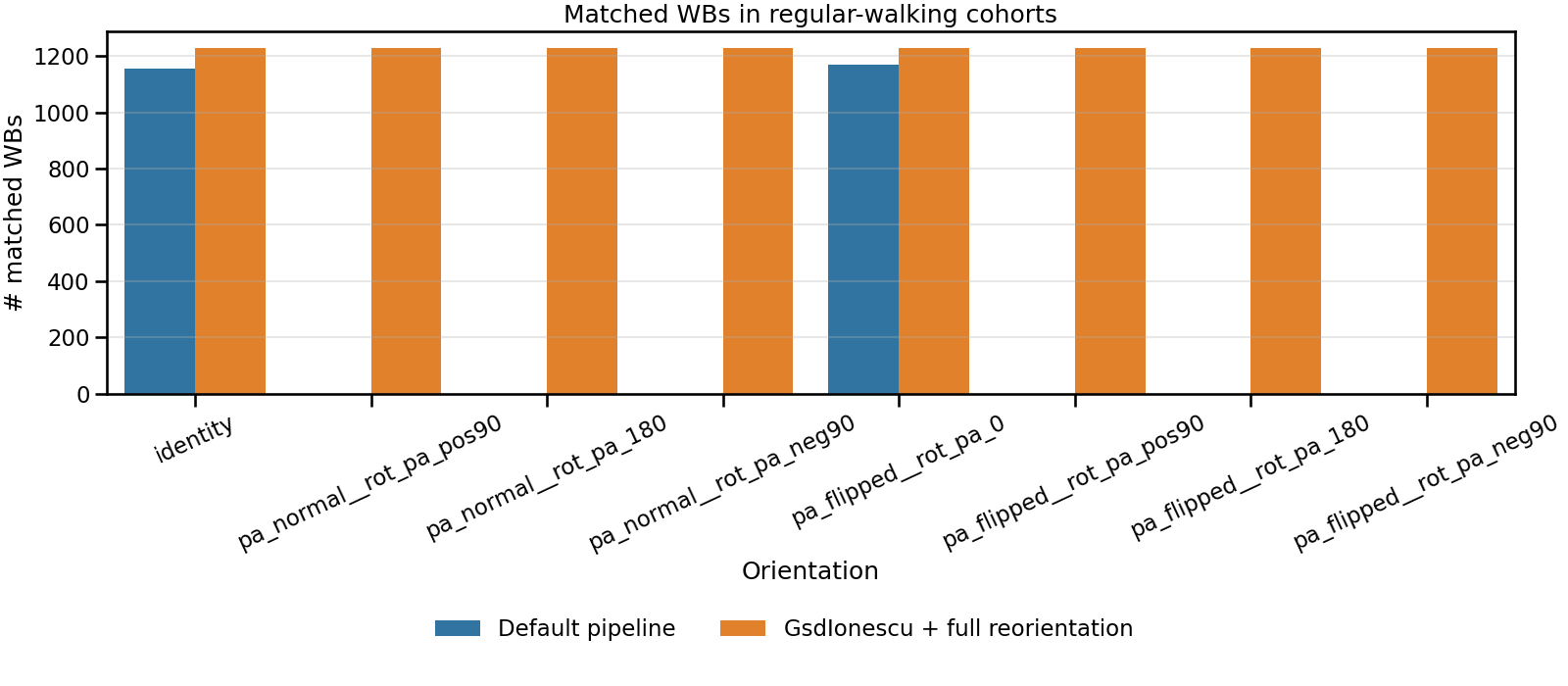
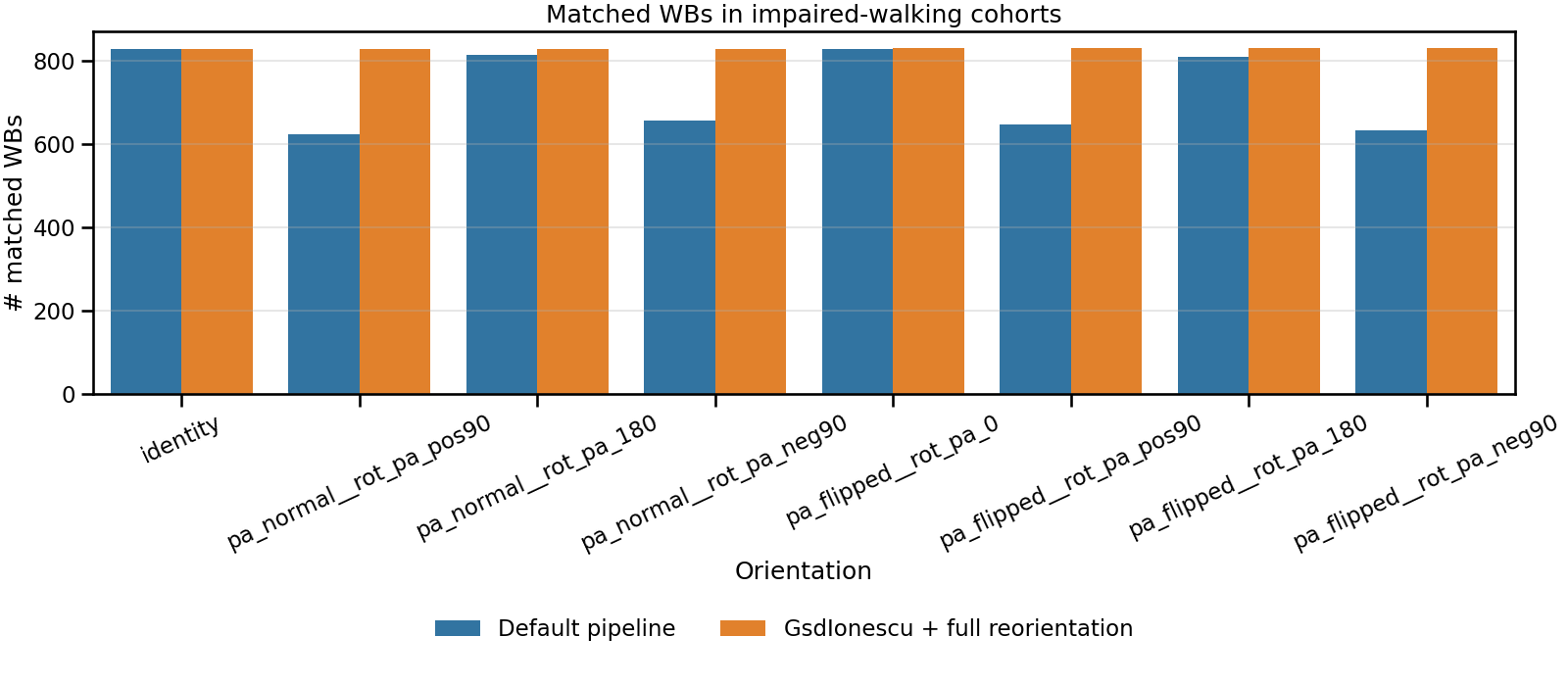
These tables and plots show the total number of matched walking bouts per pipeline variant and simulated orientation. They are split by cohort group because the official healthy and impaired sub-pipelines differ downstream.
matched_wb_counts_regular = matched_wb_count_table(
    cohort_group_data(free_living_results, regular_walking_cohorts)
)
matched_wb_counts_regular  # noqa: B018
matched_wb_counts_impaired = matched_wb_count_table(
    cohort_group_data(free_living_results, impaired_walking_cohorts)
)
matched_wb_counts_impaired  # noqa: B018
plot_matched_wb_counts(
    cohort_group_data(free_living_results, regular_walking_cohorts),
    title="Matched WBs in regular-walking cohorts",
)
plot_matched_wb_counts(
    cohort_group_data(free_living_results, impaired_walking_cohorts),
    title="Matched WBs in impaired-walking cohorts",
)
Identity-Orientation Walking-Speed Error Correlation#
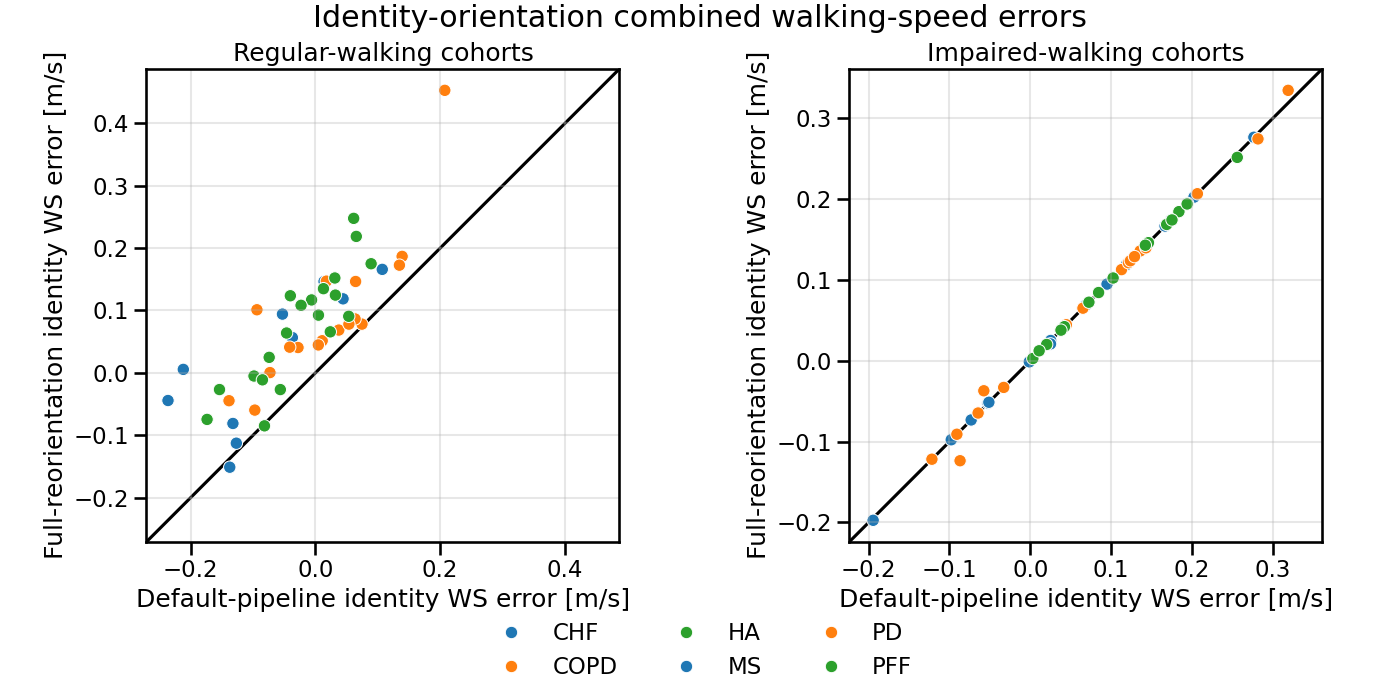
This plot checks whether enabling full-mode reorientation changes walking-speed performance when the simulated mounting is already correct.
plot_identity_walking_speed_error_correlation(free_living_results)
Regular-Walking Cohorts#
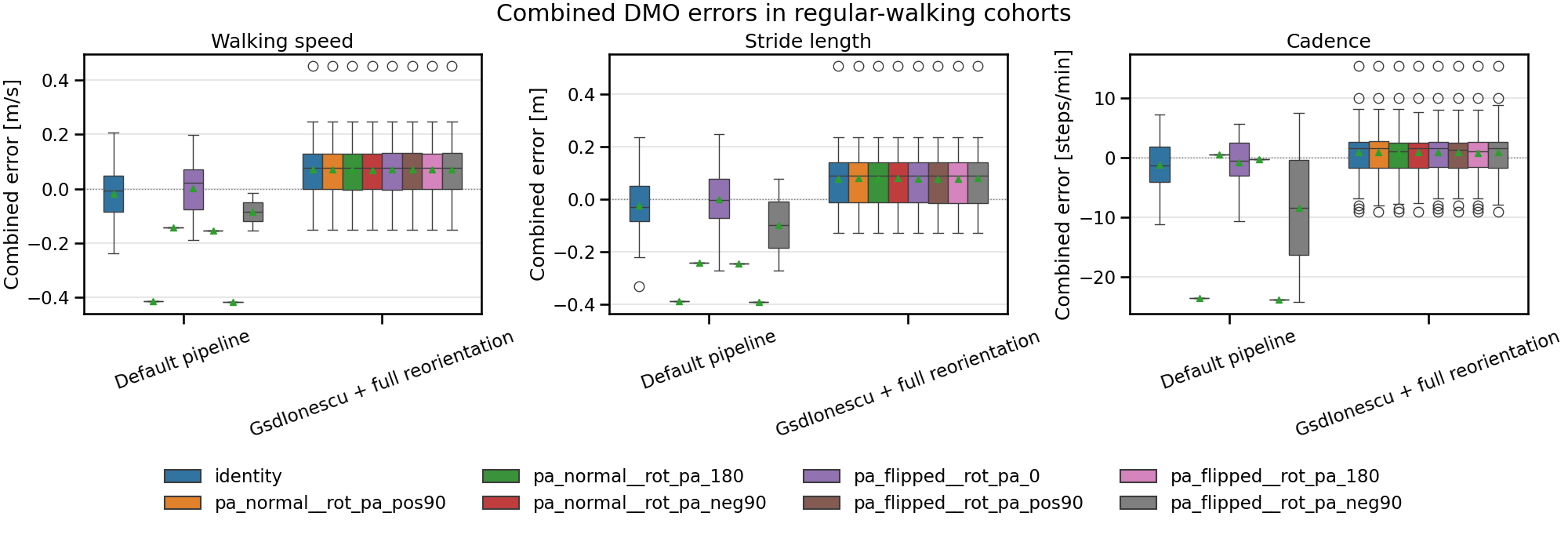
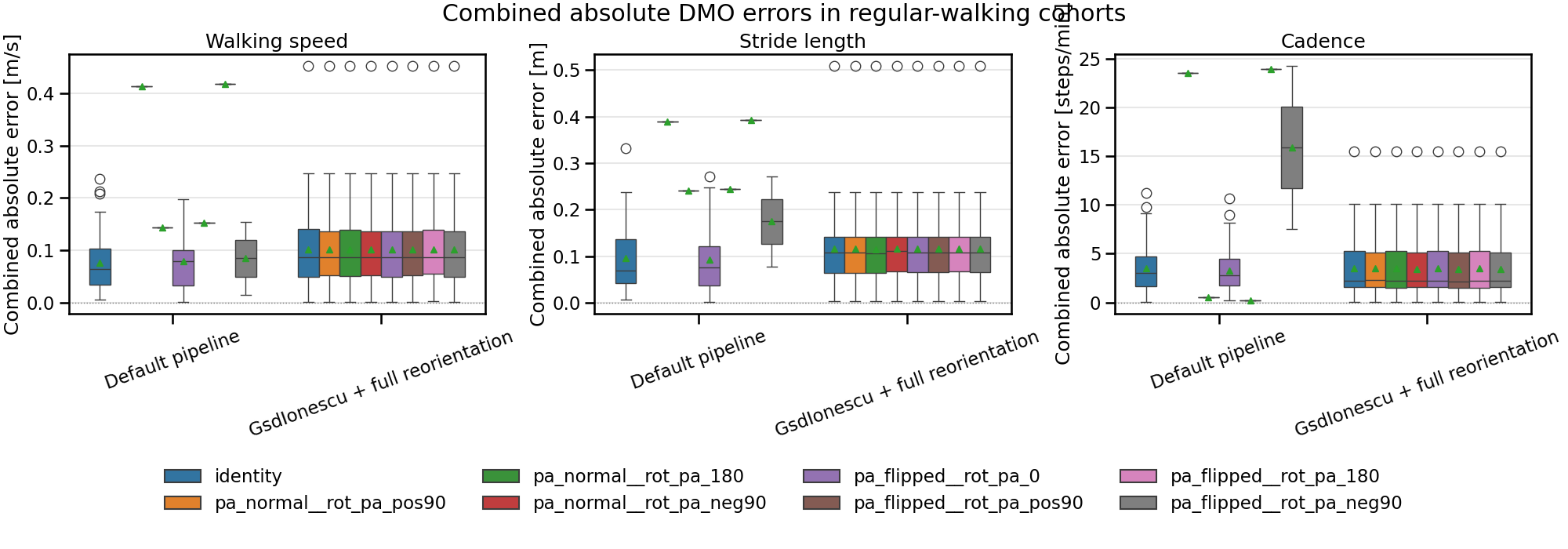
GsdIluz is the default GSD for these cohorts. It remains part of the
default-pipeline baseline, but the full-mode reorientation variant uses
GsdIonescu because GsdIluz cannot run before per-GS reorientation.
plot_combined_error_boxplots(
    cohort_group_data(combined_errors, regular_walking_cohorts),
    title="Combined DMO errors in regular-walking cohorts",
    ylabel_prefix="Combined error",
)
plot_combined_error_boxplots(
    cohort_group_data(combined_abs_errors, regular_walking_cohorts),
    title="Combined absolute DMO errors in regular-walking cohorts",
    ylabel_prefix="Combined absolute error",
)
Impaired-Walking Cohorts#
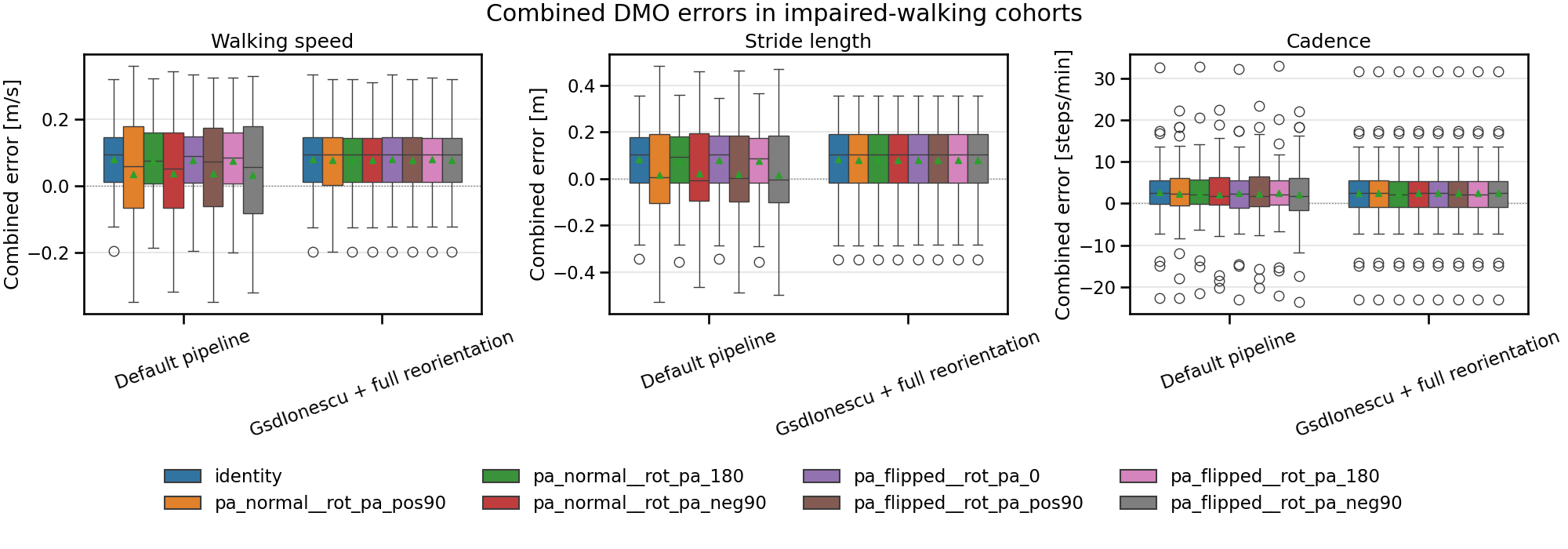
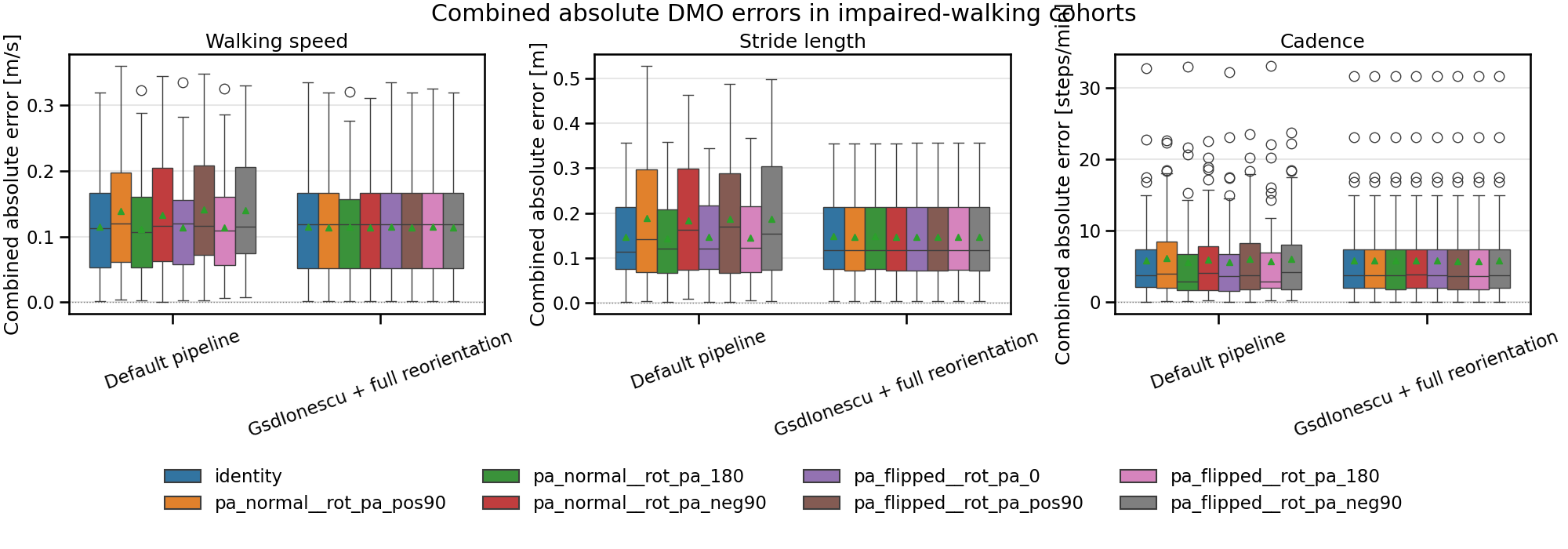
These cohorts already use GsdIonescu in the default pipeline, so the main
change for the modified variant is enabling full-mode per-GS reorientation.
plot_combined_error_boxplots(
    cohort_group_data(combined_errors, impaired_walking_cohorts),
    title="Combined DMO errors in impaired-walking cohorts",
    ylabel_prefix="Combined error",
)
plot_combined_error_boxplots(
    cohort_group_data(combined_abs_errors, impaired_walking_cohorts),
    title="Combined absolute DMO errors in impaired-walking cohorts",
    ylabel_prefix="Combined absolute error",
)
Total running time of the script: (0 minutes 9.186 seconds)
Estimated memory usage: 83 MB